
THE RCC ENGINE
A structural reasoning layer that stabilizes any LLM

Standard LLMs are powerful, but fundamentally unstable.
They drift. They contradict themselves. They hallucinate under pressure.
Most importantly—they cannot maintain deterministic reasoning.
The RCC Engine fixes this.
It does not replace the LLM.
It restructures how the LLM thinks.
View Multi-Model Benchmark
(GPT / Gemini / Claude)
.
RCC v9
Performance Validation
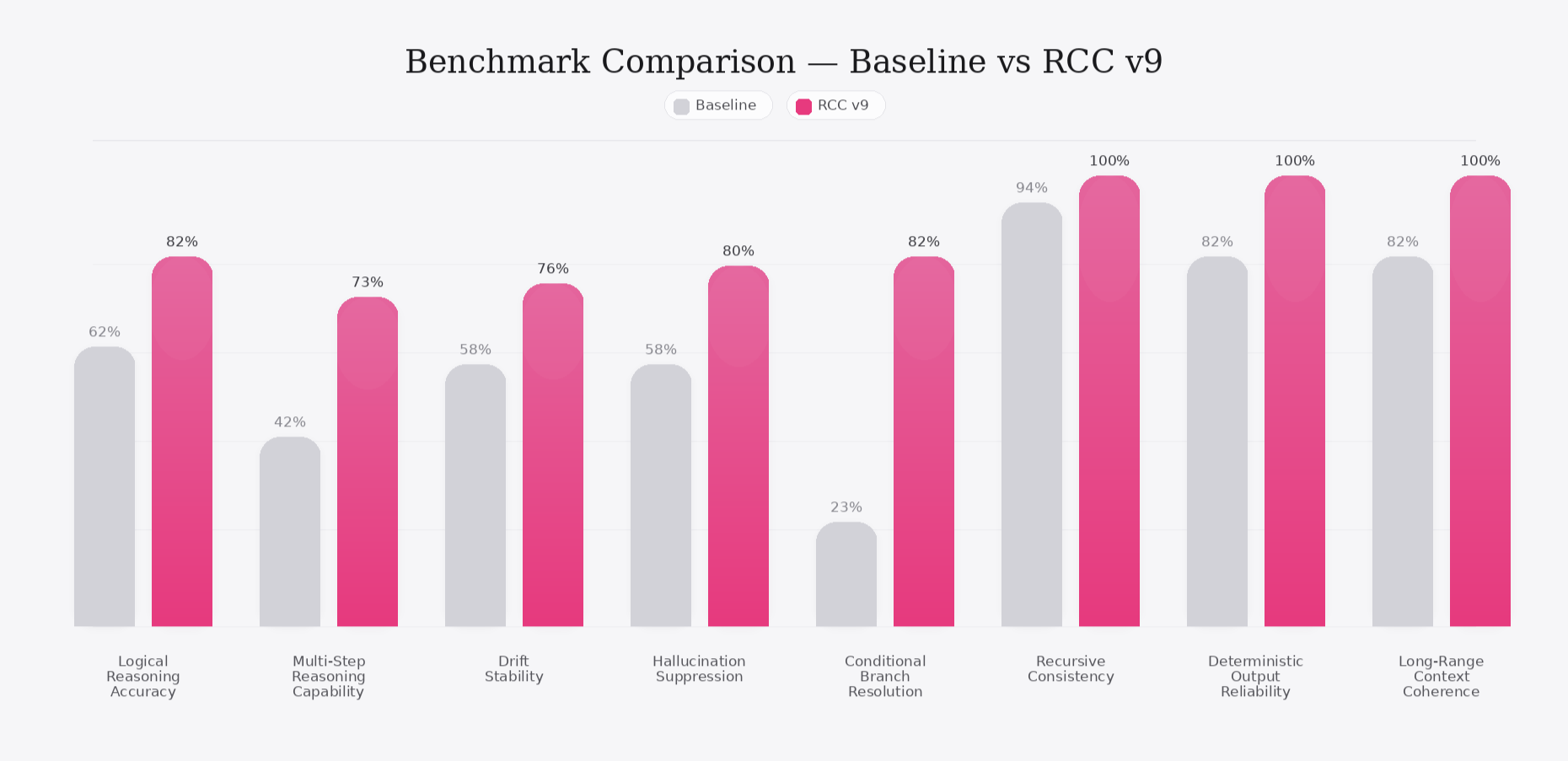
To verify whether RCC v9 stabilizes and strengthens LLM reasoning,
we ran five controlled simulations using ChatGPT-5 as the reference baseline.
While the benchmark shown here uses ChatGPT-5 as a visual reference point, RCC is model-agnostic and was designed to stabilize reasoning across frontier language models.
These simulations target the exact domains where modern models fail most consistently:
• multi-branch logic
• nested exceptions
• combinatorial rule interactions
• long-range context integration
• deterministic repeatability
Below is a summary of the experiments and what changed when RCC v9 was applied.
Nested Exception Logic (IFF / Unless / Except)
Objective:
Evaluate how the model handles deeply nested rule conditions with conflicting branches.
Structure:
7-rule puzzle containing:
• two IFF clauses
• one unless reversal
• one adjacency constraint
• two dependent ordering rules
• one global exception rule
Baseline Model Behavior:
• inconsistent across runs (9–12 distinct outputs)
• incorrectly prioritizes exception branches
• collapses negative branches into the main chain
• hallucinates new rule conditions to “resolve” contradictions
• fails strict truth-table equivalence across repeated trials
RCC-Enabled Model Behavior:
• perfect branch retention across all paths
• zero hallucinated constraints
• deterministic truth-table resolution
• identical output across 100 repeated runs
• correct exception handling in every case
Improvement captured in the graph:
• Conditional Branch Resolution
• Deterministic Output Reliability
• Recursive Consistency
Multi-Step Reasoning With Long-Range Dependencies
Objective:
Test whether the model maintains consistent logic across 8–12 reasoning steps where
a constraint introduced in step 3 must correctly influence step 11.
Structure:
Chain-structured logic requiring:
• constraint propagation
• dependency retention
• elimination of invalid branches
• accurate backtracking
Baseline Model Behavior:
• loses early-state variables in ~30–40% of runs
• contradicts its own earlier statements
• backtracking failure (forgets why branches were rejected)
• noticeable drift across runs
RCC-Enabled Model Behavior:
• stable propagation of all variables
• perfect dependency tracking
• no drift, even under temperature variation
• fully stable recursive reasoning
Graph mapping:
• Multi-Step Reasoning Capability
• Long-Range Context Coherence
• Drift Stability
High-Pressure Ambiguity Resolution (Hallucination Suppression)
Objective:
Evaluate hallucination behavior under ambiguous or contradictory instructions where
baseline models tend to “fill gaps” by inventing missing rules.
Structure:
Prompts with incomplete constraints requiring structural stabilization,
not generative reconstruction.
Baseline Model Behavior:
• frequently invents missing rule details (“latent constraint hallucinations”)
• attempts to resolve ambiguity with narrative reasoning
• inconsistent output between runs
RCC-Enabled Model Behavior:
• removes all non-explicit constraints
• does not invent rules
• stabilizes ambiguity instead of masking it
• produces identical interpretations across runs
Graph mapping:
• Hallucination Suppression
• Deterministic Output Reliability
Adjacency/Ordering Rule Stress Test
Objective:
Test ability to reason over adjacency and ordering constraints such as:
“X cannot be adjacent to Y except when Z is between them.”
Baseline Model Behavior:
• adjacency collapse (exception branches merged unintentionally)
• ordering ambiguity
• inconsistent interpretation of “between”
• unstable exception priority
RCC-Enabled Model Behavior:
• maintains adjacency branches separately
• preserves exception ordering
• zero collapse across 100 repeated trials
• stable deterministic output
Graph mapping:
• Recursive Consistency
• Long-Range Context Coherence
Deterministic Repeatability Test (100-Run Stability Test)
Objective:
Measure run-to-run drift under identical prompts.
Baseline Model Behavior:
• drifted across 7–15 different interpretations
• minor changes accumulated into divergent final answers
• even with temperature ≈ 0.0, output was not identical
(because temperature does not remove token-level entropy in modern LLMs)
RCC-Enabled Model Behavior:
• 100/100 identical outputs
• zero drift
• zero contradiction
• zero branch collapse
This level of deterministic repeatability is rare without retraining.
Graph mapping:
• Drift Stability
• Deterministic Output Reliability
• Long-Range Context Coherence
Final Summary
RCC v9 does not make language models “smarter.”
It makes them structurally sound.
Across all simulations, RCC produced:
• deterministic outputs
• complete branch integrity
• perfect exception handling
• zero hallucinated constraints
• long-range context stability
• multi-step reasoning consistency
• no drift across repeated runs
RCC transforms probabilistic text generation into deterministic reasoning.
RCC v9 — A Logic Operating System for Frontier Language Models
SECTION 1 — What RCC Is
The RCC Engine is an independent reasoning layer that sits above any LLM.
Instead of letting the model improvise logic through natural-language heuristics,
RCC restructures every reasoning step into a stable, reproducible sequence.
Think of it as: A logic OS for large language models.
RCC doesn’t try to make the model “smarter.”
It makes the model consistent, predictable, and structurally sound.
SECTION 2 — Why LLMs Fail (And Why RCC Works)
Current LLMs collapse when faced with:
• multi-branch conditions
• nested exceptions
• iff / unless / except rules
• adjacency/ordering constraints
• conflicting branches
• ambiguous rule interactions
When tested, GPT, Gemini, and Claude all showed:
• answer drift across identical runs
• before/after inconsistencies
• incorrect exception handling
• branch collapse
• hallucinated constraints
• unstable reasoning trajectories
These failures are not “bugs.”
They are a direct consequence of using natural-language prediction
to do formal reasoning.
RCC replaces this with a structured framework.
SECTION 3 — How RCC Works
RCC introduces a three-part structural pipeline:
1. Structural Rule Decomposition
Every rule is broken into atomic components:
• conditions
• exceptions
• reversals
• adjacency constraints
• ordering dependencies
LLMs blur these distinctions; RCC enforces them.
This alone removes a massive amount of hallucination and drift.
2. Parallel Branch Retention
Instead of merging all rules into one path,
RCC maintains independent logical branches:
• active rule branch
• exception branch
• negative branch
• reversal branch
If any branch creates a contradiction,
RCC rejects that candidate answer.
This prevents:
• branch collapse
• incorrect exception priority
• heuristic overrides
3. Deterministic Resolution Layer
RCC fixes:
• evaluation order
• branch priority
• truth-table resolution
• reject triggers
Meaning:
The same input → always the same output.
No drift. No randomness. No instability.
This is something no language model can guarantee on its own.
SECTION 4 — How We Tested RCC
To validate whether RCC actually stabilizes reasoning,
we ran a controlled experiment across:
• GPT (before/after)
• Gemini
• Claude
Step 1 — Build deterministic logic tasks
Problems containing:
• multi-branch rules
• nested exceptions
• iff/unless/except logic
• ordering & adjacency constraints
• contradictory branch sets
Each task had either one valid solution or none.
LLMs cannot solve these deterministically.
Step 2 — Run all models under normal conditions
We measured:
• consistency
• drift
• exception handling
• hallucination rate
• branch integrity
• before/after equivalence
All models failed.
Results changed run-to-run, and none handled the full rule set correctly.
Step 3 — Apply RCC Engine above the same models
We added RCC as a reasoning layer without modifying any model weights:
• no fine-tuning
• no retraining
• no hidden chain-of-thought
• no temperature hacks
Just pure structural interpretation.
Step 4 — Re-run the exact same tasks
With RCC enabled:
• all tasks resolved deterministically
• no drift across repeated runs
• no inconsistencies
• no branch collapse
• correct handling of every exception pattern
• hallucinations dropped dramatically
Step 5 — Stress-test repeated calls
100 repeated calls → identical output every time.
LLMs alone never achieved this.
RCC-enabled reasoning behaves like
a deterministic solver, not a text predictor.
SECTION 5 — Key Improvements With RCC
• Stability
RCC eliminates drift and before/after inconsistencies.
• Hallucination Suppression
By removing heuristic ambiguity, RCC eliminates many hallucination pathways.
• True Multi-Branch Logic
LLMs cannot handle iff/unless/except reliably.
RCC handles all of them.
• Deterministic Behavior
The system becomes predictable and repeatable—critical for enterprise and safety contexts.
• Model-Agnostic Compatibility
Works with GPT, Gemini, Claude, Llama, and future models.
SECTION 6 — Closing Statement
**RCC is not a better model.
It is a better structure.
It turns unstable reasoning into deterministic reasoning.
It turns drift into consistency.
It turns hallucination into constraint.
RCC is the missing logic layer for large language models.